How to Start Forex Trading for Beginners with a Simple Price Action Strategy
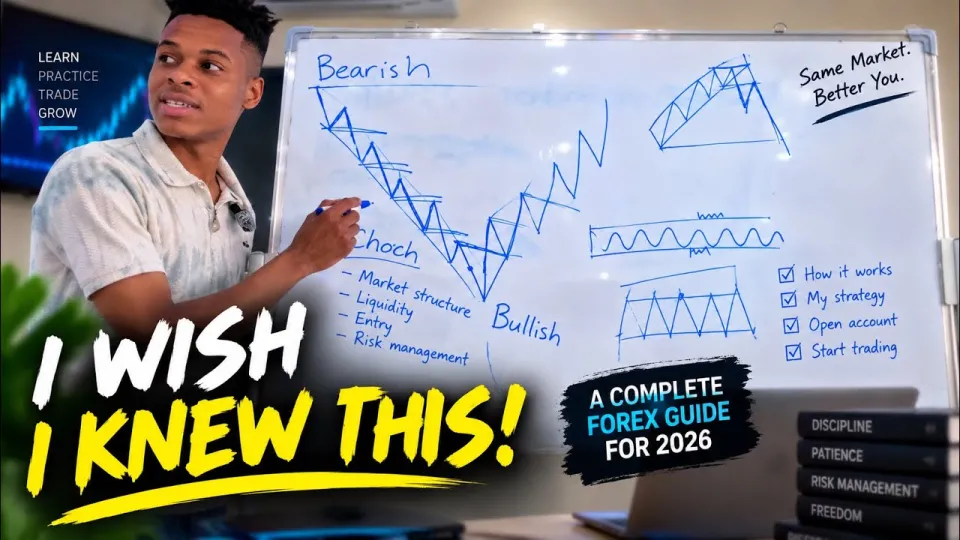
Video: How To Start Forex Trading For Beginners in 2026 (Full Guide + My Strategy)
Need articles like this for your video? They help promote it on YouTube and Google — order them in the Telegram bot @sat_sit_bot. Articles with your video embedded are written and posted by the bot itself — on popular topical sites (no ads). Your first 50 articles are free.
· based on the channel Carl Fx
Key takeaways
- Forex is an over-the-counter market where currencies are quoted in pairs such as EUR/USD; there is no central exchange and trading runs 24 hours, five days a week.
- A standard lot is 100,000 units of the base currency; with 1:100 leverage a 0.01 lot (micro) position needs roughly $10 of margin on a $1,000 account.
- Market structure is read through higher highs and higher lows in an uptrend and lower highs and lower lows in a downtrend; a break of that sequence signals a possible shift.
- Most beginner losses come from oversized positions, no stop-loss and revenge trading after a loss, not from a lack of indicators.
- Demo trading for at least one to three months before risking real money is the standard first step recommended in the Carl Fx walkthrough.
Forex trading for beginners starts with three concrete steps: learn how currency pairs and leverage actually work, open a broker account and practise on a demo until your results are consistent, then trade a small live account with a fixed risk limit per trade. Everything else — indicators, signals, prop firms — is secondary to those three steps, which is the core message of the Carl Fx beginner walkthrough. You can follow the same account-opening route he uses through TFC Global Markets registration, though any regulated broker with a demo account works for the learning phase.
What forex trading actually is and how the market is structured
Forex is the market where national currencies are exchanged in pairs, and the price you see is simply how many units of the quote currency one unit of the base currency costs. EUR/USD at 1.0850 means one euro buys 1.0850 US dollars. There is no central exchange: trades are executed over the counter through a network of banks, liquidity providers and retail brokers, which is why spreads and execution differ from broker to broker.
The market runs continuously from Sunday evening to Friday evening (London time), split into four sessions: Sydney, Tokyo, London and New York. Liquidity and volatility peak when London and New York overlap, roughly 13:00–16:00 London time, which is when most intraday strategies produce their cleanest setups.
A few mechanics every beginner must understand before placing a trade:
- Lot size. One standard lot is 100,000 units of the base currency. A mini lot is 10,000 and a micro lot is 1,000. Most beginners should trade micro lots (0.01) until they have a track record.
- Pip value. For most pairs a pip is the fourth decimal place; on a standard lot one pip is about $10, on a micro lot about $0.10.
- Leverage and margin. Leverage lets you control a large position with a small deposit. At 1:100, a 0.01 lot on EUR/USD requires roughly $10–11 of margin. Leverage magnifies losses exactly as it magnifies gains, and margin calls arrive faster than most new traders expect.
- Spread and commission. The spread is the difference between bid and ask and is your immediate cost on every trade. On EUR/USD it is typically under 1 pip at a good broker, but it can widen sharply around news releases.
How to open a trading account and get started from zero
Opening an account takes minutes, but the choices you make at sign-up determine your costs and your safety for years. The practical sequence looks like this:
- Choose a regulated broker. Check that the entity holding your money is licensed by a recognised regulator and that client funds are segregated. Carl Fx discloses in the video description that he owns TFC Global Markets and that his sign-up link promotes his own brokerage — a useful reminder to always read the disclosure before registering anywhere.
- Register and verify identity. You will need a passport or ID and proof of address; this is standard KYC and protects your withdrawal rights.
- Open a demo account first. Fund it with the same amount you plan to use live, so the position sizes feel realistic.
- Deposit only risk capital. Money you can lose without changing your life. Many brokers accept $50–$200 minimums, and starting small is a feature, not a limitation.
- Install a charting platform. MetaTrader 4 or 5, TradingView or the broker's own app all work; the goal is clean candlestick charts on at least two timeframes.
Reading bullish and bearish markets through market structure
Market structure is the skeleton of price action: it tells you who is in control and where the next decision point sits. In a bullish market, price prints higher highs and higher lows; in a bearish market, lower highs and lower lows. When that sequence breaks — for example, price fails to make a new high and then closes below the last higher low — the market is signalling a possible shift in control.
A beginner-friendly way to map structure on any pair:
- Open the daily or 4-hour chart and mark the last three or four swing highs and swing lows.
- Label the trend: rising sequence, falling sequence or sideways range.
- Drop to the 15-minute or 1-hour chart only to time entries inside the direction of the higher-timeframe trend.
- Mark the levels where the trend would be invalidated — those become your stop-loss references, not arbitrary pip distances.
This is why price action beats indicator stacking for beginners: candles and swing points are objective, they do not lag, and they work the same on gold, indices or any currency pair.
A simple price action strategy a beginner can practise
The strategy Carl Fx builds the guide around is deliberately plain: trade with the higher-timeframe trend, wait for price to pull back into a zone, and enter on a confirmation candle with the stop beyond the structure. In practice:
- Bias. On the 4-hour chart, decide direction from market structure — bullish, bearish or unclear. If unclear, no trade.
- Zone. Mark the last area of consolidation or the order block that produced the impulse leg in the direction of the trend.
- Trigger. Wait for price to return to the zone and print a rejection candle (pin bar, engulfing) on the 1-hour or 15-minute chart.
- Entry and stop. Enter after the confirmation close, place the stop-loss beyond the swing that created the zone, never at a round number of pips.
- Target. Aim for the previous high or low, and require at least a 1:2 risk-to-reward ratio; if the structure does not offer that distance, skip the trade.
- Risk. Cap risk at 0.5–1% of the account per trade. On a $1,000 account that is $5–$10, which is why micro lots matter early on.
Practise this on a demo for at least 30–50 trades and journal every one: screenshot, reason for entry, result, and what you would repeat. The journal, not the strategy, is what usually separates traders who survive year one from those who do not.
Common beginner mistakes and the doubts viewers raise
The mistakes that end beginner accounts are boring and repetitive: too much leverage, no stop-loss, moving the stop to avoid a loss, and doubling position size after a losing trade. A single revenge trade at 10% risk can erase a month of careful 1% gains, and that asymmetry is the whole reason risk management exists.
Viewer questions around the guide cluster into a few practical themes. Many ask whether they can start with a very small account — yes, and the honest answer is that the first account is for learning execution and psychology, not for income. Others struggle with opening a live account because of verification or funding issues; that is usually a KYC document problem or a payment method the broker does not support, and support chat resolves it faster than any workaround. A recurring request is for chart examples, because structure and zones make far more sense drawn on a real chart than described in text — screenshot your own charts and mark them up as you study. And the most common silent doubt, voiced by beginners who feel lost, is simply pace: most people need weeks, not days, before entries start looking obvious.
Where to follow the strategy and open an account
All the material referenced in this guide comes from the Carl Fx channel, and the two links from the video are the practical next steps: the broker registration page where you can open a demo or live account through his referral, and the free Telegram community where setups and questions are discussed.
- Account registration (TFC Global Markets, owned by the channel author): https://www.tfcglobalmarkets.com/sign-up?ref=CARLFX
- Free Telegram community: https://t.me/carlsmcforex
Final thoughts on starting forex the right way
Forex rewards patience and process far more than cleverness, and the beginners who last are the ones who treat the first months as an education rather than a payday. Learn how pairs, lots and leverage work, open a demo, map market structure on the 4-hour chart, and only risk a fixed 0.5–1% once your journal shows a consistent edge. The Carl Fx walkthrough is a solid starting curriculum because it keeps the strategy simple and puts risk management ahead of profit promises. When you are ready to trade, you can register an account with TFC Global Markets and start on demo before going live. Trading involves significant risk and profits are never guaranteed.
Questions & answers
How much money do I need to start forex trading?
You can open a live account with as little as $50–$200 at many brokers, but the amount matters less than position sizing. With micro lots (0.01) and 1% risk per trade, a $500–$1,000 account lets you practise real execution without exposing yourself to ruinous losses. Treat the first deposit as tuition, not as capital you need to double.
Should I start on a demo account or go straight to live trading?
Start on a demo for at least one to three months, or until you have 30–50 journaled trades with a stable process. Demo removes the emotional pressure, so it teaches execution and chart reading but not psychology. Once your rules are consistent, move to a small live account to experience real risk with money you can afford to lose.
What is market structure and why does it matter more than indicators?
Market structure is the sequence of swing highs and swing lows that shows whether buyers or sellers control price. An uptrend prints higher highs and higher lows, a downtrend the opposite, and a break of that sequence warns of a shift. It is objective and does not lag like moving averages, which makes it a better foundation for a beginner strategy.
What leverage and risk per trade should a beginner use?
Keep risk at 0.5–1% of the account per trade and treat leverage as a margin requirement, not as a target. High leverage such as 1:500 is available at many brokers but increases the speed at which a bad streak destroys an account. A stop-loss placed beyond market structure plus a fixed risk percentage is what actually protects the account.
Source: How To Start Forex Trading For Beginners in 2026 (Full Guide + My Strategy) · Markdown version